Intelligence Is Prediction, and Prediction Has a Ceiling
Hurricane forecasts improved for decades and never became perfect. Chaos and quantum uncertainty cap any predictor, so AI quality levels off while use keeps spreading.
By Geordie Everitt
The Boeing 707 of 1958 cruised at roughly Mach 0.8. Today's airliners cruise at about Mach 0.78 to 0.85. In between came the Concorde at twice the speed of sound, retired in 2003. Aeronautics did not stop being understood. The air pushed back: near the speed of sound, drag climbs steeply, and every extra sliver of speed costs disproportionate fuel. Passenger flights, meanwhile, multiplied. Speed stood still while use kept growing.
I think AI is on the same kind of road, for the same kind of reason. The reason starts with a premise I hold, that intelligence is prediction: a brain, or a model, takes what it has seen and estimates what comes next. If that is right, intelligence inherits the limits of prediction, and those limits are physical.
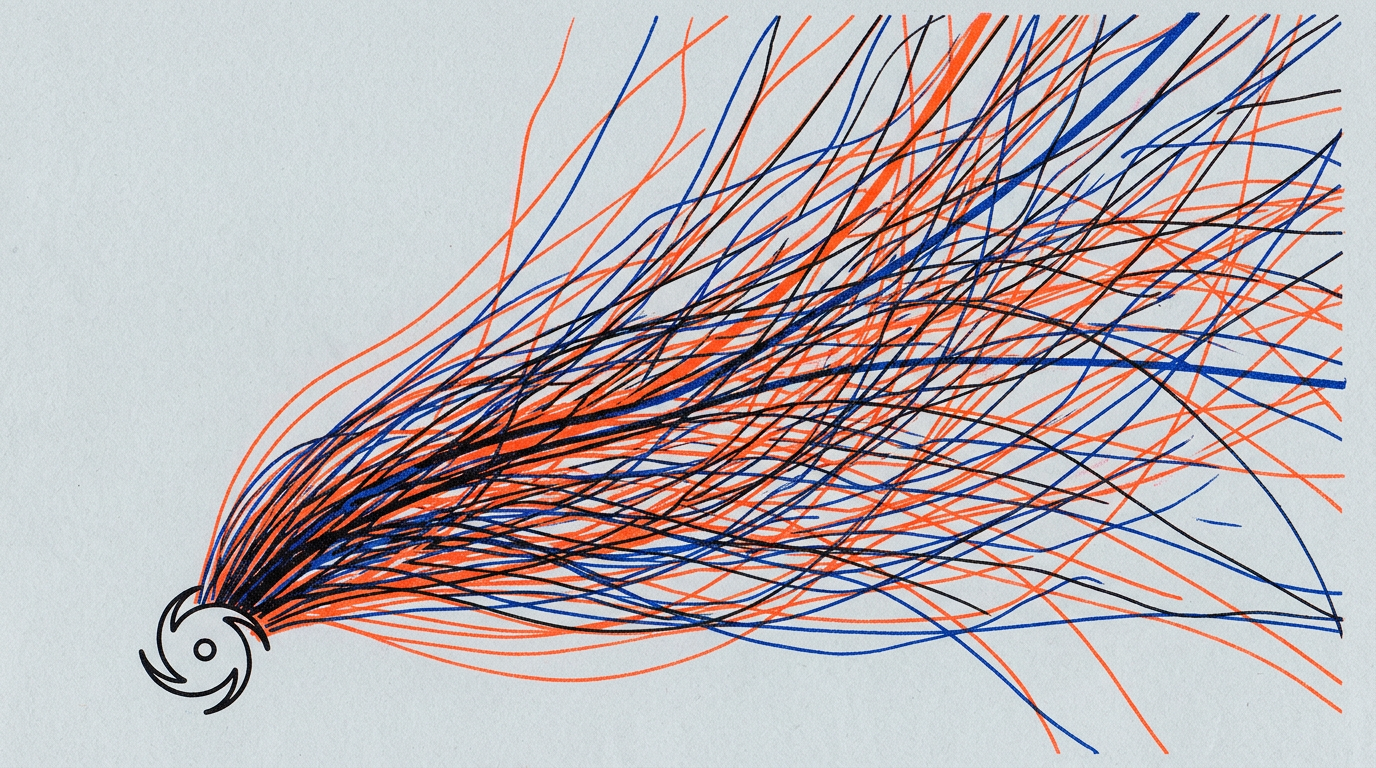
The spaghetti plot
When a hurricane forms, forecasters run many models and draw each model's predicted path on one chart. The result looks like a tangle of spaghetti, and the spread of the strands is the uncertainty. Over decades the strands have tightened. The National Hurricane Center's track errors at one to three days fell by 70 to 75 percent, and a five-day forecast today is as accurate as a three-day forecast was in 2001. In recent years the gains have slowed. No single strand has ever been perfect five days out, and the physics says none will be. From the tangle the Hurricane Center draws a cone, a widening band sized so that, historically, the storm's center stays inside it about two-thirds of the time. By design, it misses one time in three.
Why it stops
Two things set the ceiling. The first is chaos. The three-body problem, three masses pulling on one another, has no practical general formula, and small errors in the starting positions grow exponentially. The atmosphere behaves the same way. That produces a diminishing return you can put a number on: a 2019 study estimated that cutting the error in today's starting data by a factor of ten would extend a midlatitude weather forecast by at most about five days, from roughly ten to roughly fifteen. Each tenfold improvement buys the same fixed slice of time, not ten times as much.
The second is quantum. Heisenberg's uncertainty principle says you cannot know a system's starting state perfectly, even in principle, so there are always small errors for chaos to grow. In practice, instrument error is far larger than the quantum limit, so Heisenberg is the limit at the end of the road, not the one that binds today.
The floor in language
Language models face the same shape of limit. What they predict is what a person says next, and that depends on a mind and a world the text does not contain. The scaling-law research that guided the last few years of model building writes this in: error falls as models and data grow, plus a term that does not fall, which the authors identify with the entropy of natural text itself. A model can approach that floor and cannot cross it.
We do not know how close to the floor we are. Hurricane forecasters did not either, and the gains kept coming for decades. But returns diminish, and my bet is that for most everyday jobs we are close enough that a bigger model buys little.
Loops
Someone will point to the measures of how long a job an AI can finish, which keep growing. The research group METR estimated that the length of task a model can complete doubled about every seven months through 2024, and faster since 2023. That is real, but it is mostly loops. Treat each step of a job as independent. If a model gets each step right 99 times in 100, it can chain about 70 steps before the odds of finishing fall to a coin flip. At 999 in 1,000, it is about 700. A tenth of a percent more reliability per step buys ten times the length. A long job is a short job repeated, and the quality of any single completion can barely move while the horizon races.
Use is another matter
None of this says AI has little left to do. Airliner speed stopped, and flying kept spreading for another sixty years. We are far from exhausting what token completions can be used for. The ceiling is on the quality of the stream, not on how much of it the world can find a use for.
That is why the last two pieces in this series fit with this one. Models whose quality levels off become interchangeable, so a moat made of them is not a moat, and what is left to compete for is attention.
Forecasters never got a perfect strand. They drew a cone that admits it will miss about one time in three, and people plan around it.