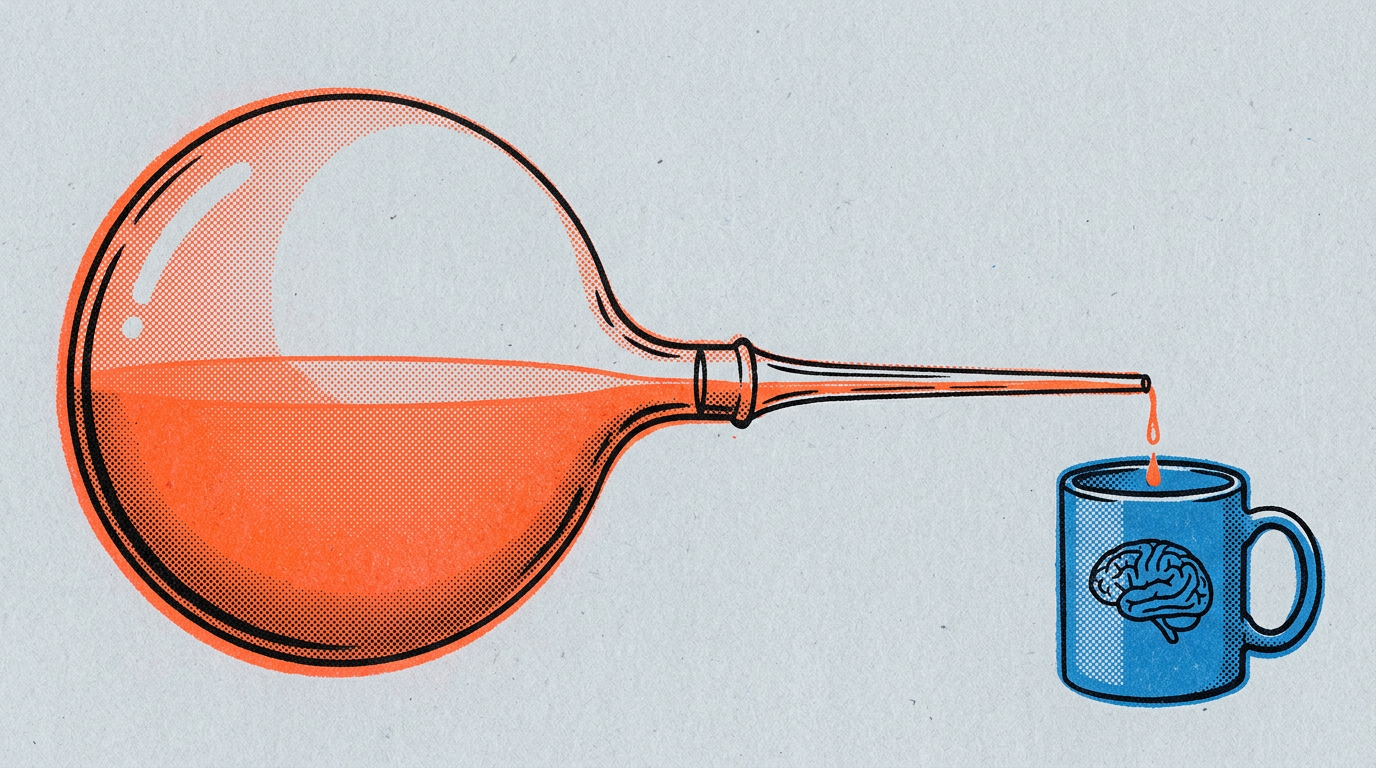
The Bottleneck Is You
Language models have effectively read every book ever written. You process what they hand back at a fixed fifty bits a second, a number that hasn't moved in your species' history. That fixed rate is the actual chokepoint.
By Geordie Everitt
You haven't read every book in your local library. Claude has. So has ChatGPT, Gemini, and Qwen.
They have consumed everything you have ever read, and most of what you haven't. Every accessible book, every research paper, every forum argument and product manual: distilled into tokens, mapped into arrays of floating-point numbers, stored as microscopic voltage differences on a chip. A prompt is just a vector that sits somewhere in that space. The model reconstructs an answer the way it reconstructs everything: predicting one number after another until the pattern matches what trillions of examples taught it a good answer looks like.
That description is about as literal as anything written about these systems gets.
The Bottleneck Arrives
Then the answer has to go somewhere, and that is where the system stops being impressive.
It arrives at you. Your eyes and ears take in something on the order of eleven million bits of raw sensory data every second. In 1989, the physiologist Manfred Zimmermann tried to measure how much of that reaches conscious awareness, the part of you doing the reading and the deciding. His estimate: about fifty bits a second. Researchers have approached the same question from different angles since, and the number holds close to his. Tor Nørretranders built an entire book, The User Illusion, around what that gap implies.
Relative to eleven million, fifty is a rounding error.
The actual chokepoint is you: specifically, the fifty-bit drinking straw your species evolved instead of a fire hose.
Why the Straw Never Got Wider
The straw was never going to get wider, because it was not built for throughput. It was built for triage. An animal that noticed everything died as often as one that noticed nothing. Noticing everything means reacting to none of it in time. Consciousness is the part of the nervous system that decided which fraction of the incoming signal was worth a response. It made that call over a very long stretch of evolutionary time.
Put the number in engineering units, and fifty bits a second is exactly what a filter tuned purely for staying alive looks like.
The gap between what a model can generate and what you can absorb is the permanent shape of the problem. Silicon scales. Add GPUs, and the model reads more, writes faster, holds a longer context. The straw does not scale. It has been fifty bits a second since long before anyone measured it, and nothing on a hardware roadmap changes that.
The Bridge Already Solved This
A starship bridge, as a piece of design, is the clearest illustration I know of an organization built entirely around this constraint. A ship in the middle of a mission is drowning in telemetry. Every sensor, every subspace signal, every system readout arrives continuously, and none of it is prioritized on its own. The bridge crew exists to do one job before anything else: compress that flood into the handful of facts the person in the center chair can act on. Tactical calls out the threat. Ops summarizes the ship's status in one line. The viewscreen shows a single image instead of forty simultaneous sensor feeds. The captain's fifty bits a second are the scarcest resource on the ship. The command structure exists to protect them.
No one built a research department to ask whether the captain could simply be trained to process more information faster. The answer that actually holds up is building a crew whose job is deciding what reaches the chair at all.
Who Is Doing Your Bridge Crew's Job
Off the ship, no one is filtering your fifty bits on your behalf, on purpose, for your benefit. Something is still filtering them, because the straw does not admit otherwise. Recommendation engines, notification systems, and now a fast-growing category of AI products are all competing for the exact same fixed channel. Any of them can generate a plausible answer now, at industrial scale, because the reading has already been done. What they're actually competing over is who reaches your fifty bits first. Whoever gets there first gets to spend them.
That reframes a question most people ask badly. "Is this AI tool good" is close to the wrong test, because good is cheap now. Distilling the entire written record makes a plausible-sounding output nearly free to produce. The better question is who is sitting in your bridge crew's chair: who decides what gets summarized, what gets flagged, and what never reaches you at all. Sometimes that is a person you trust. Increasingly it is a system built for a business someone else runs, and it never disclosed that it took the job.
Something is always competing for your attention: a feed, a notification, an AI system offering an answer before you finished forming the question. Ask it the question a bridge crew would ask about any incoming signal. What is this. Why does it deserve my fifty bits before something else does. Who decided the priority order I am now operating on. The library has already been read. What happens to the reading you actually do with what's left of the day is still, for now, up to you.