There's No Such Thing as "AI Ethics"
A large language model only ever produces text. Treating that text as a novel ethical category, rather than as speech, is where the argument goes wrong.
By Geordie Everitt
I sat through a talk at the AI Summit last week. A major European defense contractor was recruiting. The speaker asked the room to consider a career in European defense and technology.
It was a good pitch. The speaker knew the room would flinch at the words "defense contractor." That flinch is earned. The military-industrial complex has a long, ugly history. So a third of the talk dealt with that history head-on. You don't talk someone out of a fair suspicion by ignoring it.
There's a reason a European contractor is making that pitch now. It isn't subtle. Since 1945, the world's democracies built their security on an American guarantee. Europe first. Then Japan and South Korea. The deal was simple: the United States would show up, and the last wave of authoritarianism would stay defeated.
That guarantee reads less certain by the year. What looks like new European ambition is really something else. A wider group of nations is relearning a skill they outsourced for two generations. Holding their own pen.
I think the wariness is aimed at the wrong target. Not because that history is undeserved. It is deserved. But the argument borrows its moral weight from that history and pins it on the technology itself, as if a language model picks up the same risks as the industry that might use it.
It doesn't. A model picks up the risks of speech. That is a much older problem, and we already understand it better than the one the slide deck was trying to solve.
The Category Error
The phrase "AI ethics" suggests that AI does something brand new, something that needs its own branch of moral philosophy, the way medicine has one and law has one. It doesn't.
Here is what a language model actually does. It builds text one small piece at a time. Each piece is called a token. String enough tokens together and you get what the industry calls a completion: the whole block of text the model hands back to you.
Tokens are words. Words are speech. People have argued about the ethics of speech since at least ancient Athens. Nobody needed a new field of ethics every time someone found a faster way to produce speech: the printing press, the telegraph, cable news, the group chat.
What a model produces is a written statement. It can produce a lot of them, fast. That volume deserves respect. It does not deserve a new category of ethics.
Look at what people actually worry about under the label "AI ethics." That the technology can deceive. Manipulate. Radicalize. Defame. Every one of those is something speech can already do when it's used badly.
None of them describes something a model can do that a large, well-funded group of humans couldn't do without it. A troll farm in Saint Petersburg does not need a language model to sow chaos in an election. It needs a shift schedule and a set of talking points. The model just makes the shift schedule shorter.
The Pen, Reconsidered
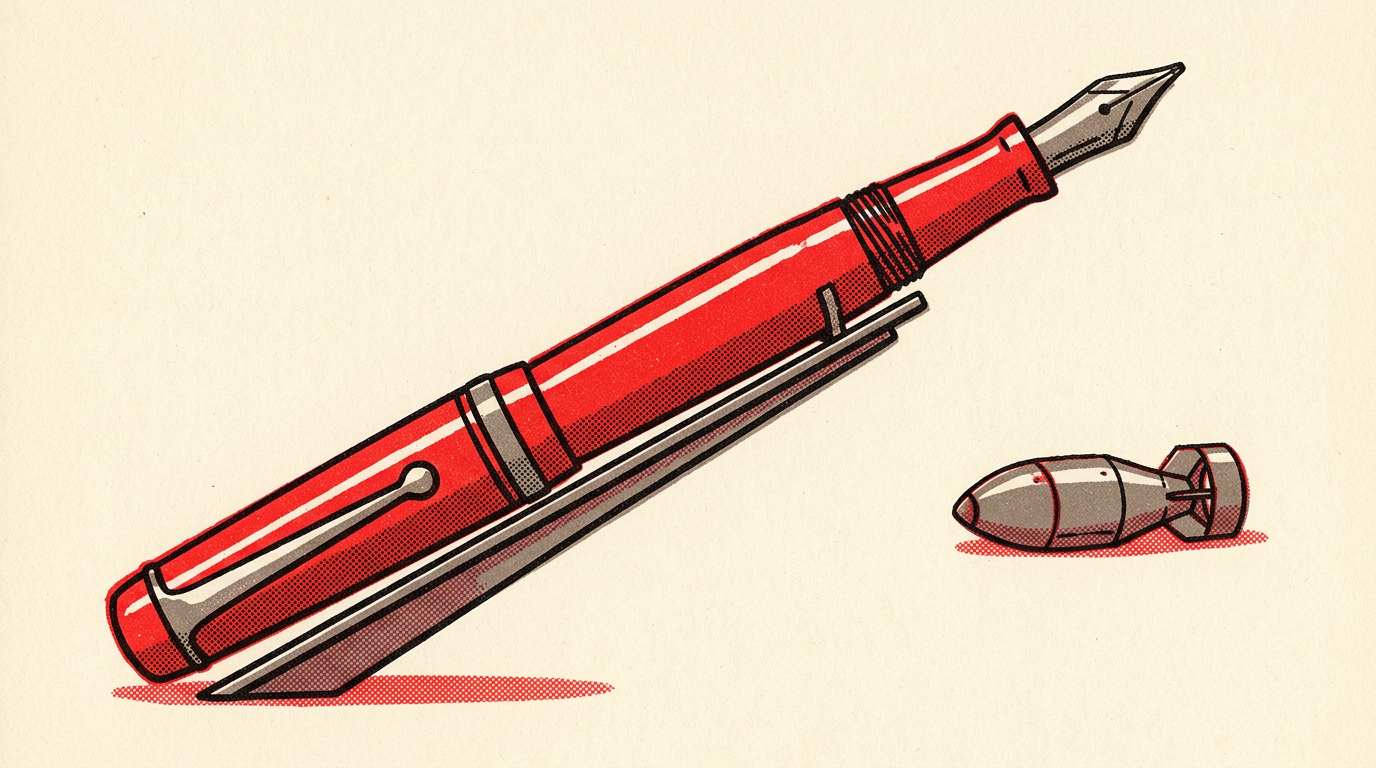
"The pen is mightier than the sword" gets repeated so often it stops meaning anything. That's a shame, because here it's exactly right. The claim was never that ink is more dangerous than steel. It was that persuasion outlasts force. Once an idea gets loose in a population, it does work a blade never could.
A completion is a pen that writes at the speed of thought and never gets tired. That is the whole invention, right there. It is not a new kind of persuasion. It's the old kind, with the brakes taken off.
If the pen was mightier than the sword, the completion is mightier than the warhead. A rumor has always beaten an artillery barrage at changing what people believe.
That should be the strongest argument for taking AI speech seriously. Instead, people use it to argue the opposite: that AI speech is a special, contaminated category. One that needs its own permission slip, its own review board, its own third of every AI Summit keynote.
That gets it backwards. If completions are speech, they already come with rules attached. We know how to weigh intent, harm, and context. We have done it since Athens. We don't need a new legal system built from scratch, on a timeline set by whoever ships the fastest model instead of whoever thinks hardest about the question.
Bias Was Never New Either
The same slide deck spent time on model bias. It was delivered with the special seriousness people reserve for a problem they think they just discovered.
A biased model is a side effect of biased training data and biased choices about that data. In other words, it's a side effect of the humans who built it. The bias just got filtered through statistics instead of a committee meeting.
This is not a new failure. It is the oldest one there is.
In the 1980s and 1990s, the first big drug trials for statins studied mostly middle-aged men. For a generation after that, doctors under-diagnosed heart problems in women, because the studies never learned to look for them there. That gap got built into the science itself.
Nobody needed a language model to get a biased result from a skewed sample. Nobody needed one to draw redlining maps, or to write sentencing rules from a skewed set of past cases, or to train a hiring manager's gut instinct on people who all looked like him.
Bias is what happens when a process learns from part of the world and then gets treated as if it learned from all of it. The model didn't invent that problem. It inherited it, and it does the job fast enough that we can finally see it clearly.
What's Actually Novel
None of this means nothing has changed. Something real has changed: the cost of producing fluent, targeted, persuasive language has collapsed. That's worth building real defenses around: rate limits, ways to trace where text came from, detection tools, the unglamorous plumbing of trust.
But that's an argument about scale and speed. It's the same argument we've had about every new printing technology since Gutenberg annoyed the scribes. It is not an argument that the words themselves belong to a new moral category just because a model wrote them instead of a person.
The contractor was right to take the room's hesitation seriously. An industry with that history should. But the conversation would move faster, and further, if people named it correctly: a question about defense work, and who gets to hold the pen. Not a debate over whether the pen itself is some strange new moral creature.
Europe can hold that pen or not. It should at least argue about the right thing while it decides.
A five-page summary of this argument is available as a PDF carousel.